Chapter 1 - THE FORBIDDEN DOOR AND THE YELLOW PAINT
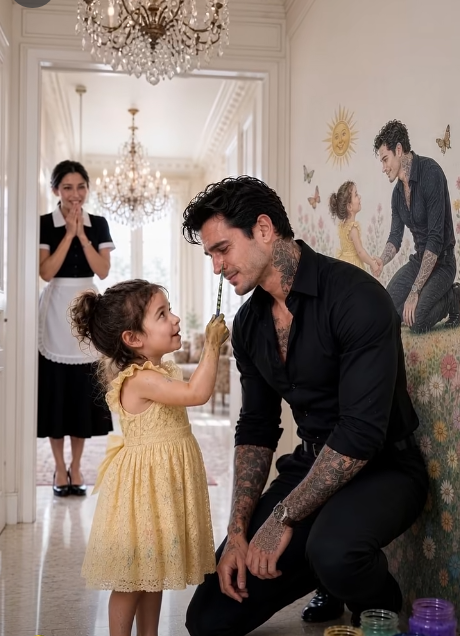
The silver tray slipped from my fingers, hitting the polished marble floor of the eastern corridor with a sharp, deafening crash. Crystal spun across the stone like shattered ice, but the sound barely registered in my mind.
My breath caught in my throat.
The door at the very end of the hallway—the heavy, dark oak door that had been locked, bolted, and sealed with strict, absolute terror for six long years—stood wide open.
A cold draft drifted out from the dark interior, carrying the faint, heartbreaking scent of dried lavender and old baby powder. In the Moretti estate, that room was an absolute taboo. Servants walked past it on tiptoe. Armed guards kept their eyes fixed straight ahead when patrolling the second floor. Even Alessandro Moretti’s most trusted lieutenants spoke in whispers if they ever had reason to approach it. It was the shrine of Isabella, Alessandro’s six-year-old daughter, who had been taken from this world in a senseless, brutal crossfire of a mafia war six years ago.
And my three-year-old daughter, Sophia, was inside.
“Sophia!”
Panic clawed at my chest, icy and sharp. I didn’t care about the broken crystal. I didn't care about the rules or the terrifying reputation of the man who owned this Manhattan fortress. Alessandro Moretti was not a merciful man; men had vanished from New York for far less offenses than tracking mud onto his foyer rugs, let alone trespassing into his deepest, most agonizing grief.
I bolted down the hallway, my soft loafers slapping frantically against the marble.
Before I could reach the threshold, I heard it.
Humming.
It was a soft, high-pitched, innocent little tune—the kind Sophia hummed whenever she was deeply engrossed in coloring her picture books.
I pushed through the open doorway, bracing myself for the worst, and froze completely.
The room was bathed in the warm, golden light of late afternoon pouring through lace curtains. But it wasn't a pristine museum of sorrow anymore. On a wooden step-stool stood Sophia, wearing her oversized hand-me-down pinafore, her tiny fingers clutching a brush dripping with bright, sunny yellow paint.
Before her stretched an unfinished wall mural—a pale, faded sun, a half-painted garden, and three lonely, delicate butterflies floating across the blank white plaster.
They were Isabella’s butterflies. Painted by a little girl who would never grow up.
And right beside them, Sophia had added five more.
An orange one. A bright blue one. A cheerful yellow one. A vibrant violet one. A sparkling green one.
They fluttered across the wall in a riot of joyful, messy life, right alongside the originals.
And sitting on the wooden floor beneath the mural, knees drawn to his chest, was Alessandro Moretti.
His immaculate, custom-tailored charcoal jacket lay crumpled near the doorway like discarded armor. His silk tie hung loose around his open collar. One large, calloused hand covered his mouth, trembling violently as tears streamed down his pale, rugged face—a face that the entire underworld feared, a face that had never shown weakness to a living soul.
“He’s sad, Mama,” Sophia whispered, turning her head to look at me with wide, innocent blue eyes. “The room was too quiet. So I helped him paint.”
My heart hammered against my ribs like a trapped bird. I rushed into the room, scooped Sophia off the stool, and pulled her tightly against my chest, shielding her body with my own.
“I’m so sorry, Mr. Moretti!” I stammered, my voice shaking so badly the words tumbled over one another. “Please—I’ll clean everything! I’ll pay for the damage! I’ll scrub the wall until it’s blank again, I swear it! Please don't hurt her, take it out on me, we’ll leave tonight, we’ll be gone before you can even blink—”
“Don’t.”
The single word was whispered, but it cut through the air with a heavy, final gravity that stopped my breathing instantly.
Alessandro didn't look at me. Slowly, with movements that seemed to cost him physical effort, he pushed himself up from the floor. He walked toward the mural, his footsteps heavy. His fingers, scarred from decades of gang wars and violent control, trembled as they reached out to touch the smallest original butterfly—the one his daughter had painted years ago.
“My daughter painted those,” Alessandro choked out, his voice thick with unspooled grief.
Only then, through my tears, did I look closer at the room.
I saw the tiny red leather shoes neatly placed beneath a small wooden chair. I saw the stacks of dog-eared bedtime books resting beside an unmade, untouched twin bed covered in a dusty pink quilt. I saw the faint, tiny fingerprints pressed into the paint near the baseboard.
Everything had been preserved, down to the exact second Isabella had left it, frozen in amber like a tragedy that refused to age.
“The butterflies were lonely,” Sophia said softly from my arms, her small hand reaching out to pat my shoulder. “They didn't have any friends. So I gave them some.”
Alessandro closed his eyes. A ragged breath shuddered through his broad chest, and something ancient and hardened inside him seemed to finally break.
I braced myself for the explosion. I braced myself for the guards, the shouting, the banishment.
Instead, Alessandro slowly sank down onto his knees once more—not in defeat, but in submission to the pure, unadulterated light of a three-year-old child. He looked up at my daughter, his dark eyes shining with tears.
“Will you come back tomorrow,” he asked, his voice cracking softly, “and finish the garden?”
Sophia tilted her head, considering the question with all the solemn wisdom of a toddler. Then, a brilliant, gap-toothed smile broke across her face.
“Yes! But Mama has to come too. She’s good at painting flowers.”
Slowly, Alessandro’s gaze lifted from the child in my arms to my face.
May you like

For the first time since I had taken the job as a maid in this grim, terrifying mansion three months ago, the man looked at me not as hired help, not as an intruder, but as a human being.
And in that quiet, sunlit room, the foundation of my entire life shifted.