Chapter 1 - Fourteen Hours in the Scrub
The fog coming off the bay had a way of cutting straight through wool, cotton, and thirty years of accumulated weariness.
By the time I killed the engine of my battered 2012 Hyundai Elantra, my knuckles were stiff, white, and aching from the cold steering wheel. Fourteen hours in the Neonatal Intensive Care Unit will take the marrow right out of a person’s bones. It isn't just the physical toll—though standing on linoleum for that long feels like walking barefoot across gravel—it’s the hyper-vigilance. It’s the continuous, low-frequency hum of monitors tracking heartbeats that flutter like trapped moths, the tiny plastic incubators humming against the silence of rooms where parents have gone home to cry because they couldn't stay another night.
I had spent my shift adjusting oxygen lines for a micro-preemie who weighed less than a bag of flour, whispering soft, senseless things into an incubator wall to keep my own hands from shaking. I had changed diapers the size of index cards, calculated medication dosages down to the hundredth of a milligram where a single decimal error meant catastrophe, and comforted a mother who looked like she might shatter if the wind blew too hard.
All I wanted when I walked up the cracked concrete steps of the house on Maple Street was silence.
Just twenty minutes of it. A hot shower to wash off the smell of antiseptic, baby shampoo, and the faint, coppery scent of anxiety that clung to my navy scrubs like smoke. I wanted to drop my heavy canvas work bag by the door, kick off my clogs, and let the hot water beat down the knots in my shoulders.
Instead, I smelled cigarette smoke and cheap vanilla air freshener before my hand even touched the brass doorknob.
The porch light—the one I had bought and installed myself after Dad let the old fixture rust out—was glaringly bright. And right there, huddled against the peeling white paint of the foyer window, stood a mountain of luggage that made my stomach drop into my shoes.
A brown leather suitcase with a broken zipper.
Three thick black contractor bags, stuffed so full the plastic groaned, tied off with yellow twist ties.
And right on top, resting precariously against a plastic laundry basket filled with my clinic shoes and old nursing textbooks, was the small, silver-framed photograph of my late Aunt Evelyn. Her sharp, intelligent eyes looked out from behind the glass, seeming to stare at the wet gravel of the driveway with quiet disapproval.
I stood in the freezing drizzle, my scrubs damp against my back, staring at my entire life bagged up like yard waste.
The front door wasn't locked. It never was. That was my first mistake, maintained out of some pathetic, stubborn habit of believing that a home should always leave a latch unlatched for the people who shared your blood.
From the kitchen came the muffled thumping of bass from a portable speaker and the sound of high-pitched, mocking laughter.
I pushed the door open. The warm air of the hallway hit me—thick, heavy, and smelling of greasy takeout and beer.
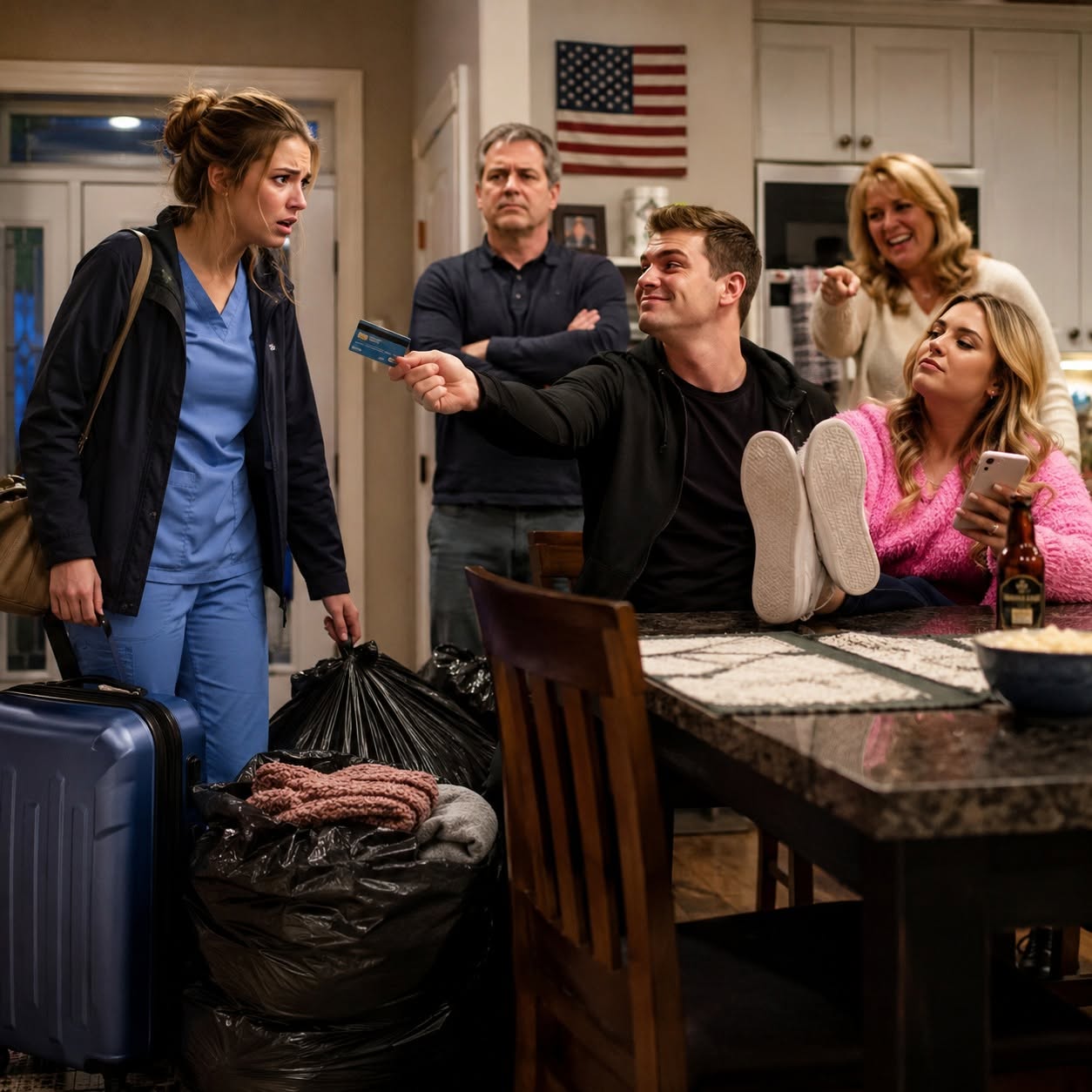
My brother Liam was leaning against the granite-tiled island that I had paid for three Christmases ago when he swore he was starting a legitimate landscaping business. He had a Miller Lite in one hand, his sneakers propped up against the cabinet doors, and his new girlfriend, Brittany, tucked under his arm like a trophy he’d won at a carnival.
Brittany was lounging on the exact barstool where I sat every morning at 5:00 AM, drinking black coffee while reviewing my clinical charts. One of my favorite hand-stitched quilts—the one Grandma Vera had given me before she passed—was draped over her shoulders like a shawl.
My mother, Sharon, was sitting at the kitchen table, slicing through a store-bought pepperoni pizza with a dull butter knife. She didn't look up when the door creaked. She didn't drop her knife.
My father, Robert, sat across from her, his reading glasses halfway down his nose, scrolling lazily through his phone while the local news droned on the small TV above the refrigerator.
For three seconds, nobody moved. The house seemed to hold its breath.
"Why are my things packed?" I asked. My voice sounded thin, scraped raw by exhaustion and the damp night air.
Liam took a slow swallow of his beer, the amber liquid glinting under the harsh overhead track lighting. He didn't look guilty. He didn't even look mildly inconvenienced. He looked like an adolescent king surveying a newly conquered province.
"Brittany’s moving in, Lily," Liam said, his voice dropping into that lazy, condescending drawl he used whenever he wanted to remind me who held the emotional cards in the family. "We talked about it. You’ve had that back room long enough. Besides, a single nurse doesn't need a three-bedroom house all to herself. It’s a waste of square footage."
I looked from Liam to my mother. Sharon finally set the butter knife down, her expression settling into that familiar, pinched look of profound annoyance—the look she always wore whenever I interrupted her television schedule or expected her to treat me like an adult.
"Don't start with the dramatics, Lily," Mom sighed, waving a hand dismissively as if I were a stray dog whining on the porch. "You’ve known for weeks that Liam and Brittany needed a proper place to settle down. They’re talking about getting a dog, for heaven's sake. They need the yard. They need the master suite."
"Weeks?" My chest tightened, a band of cold iron constricting my lungs. "Nobody told me anything. That's my house. My name is on the mortgage deed—"
"Your name is on a piece of paper that your aunt left you out of pity," Dad muttered from the corner, finally glancing up from his phone. His eyes were flat, rheumy, and entirely devoid of warmth. "And quite frankly, after everything this family has done for you—paying for your college textbooks that one semester, letting you live under our roof rent-free all those years before you got your little hospital job—you owe us. Call it back-pay."
I stared at my father, the man I had driven to dialysis appointments for eighteen straight months, the man whose prescriptions I had paid for out of my own grocery money when his insurance lapsed.
"Back-pay?" I echoed, the words tasting like copper and ash. "I bought this house three years ago with my own savings, Dad. Every single payment comes out of my account. Every single utility bill—"
Liam cut me off with a sharp snort. He pushed off the counter, walking toward me with a swagger that made my skin crawl. He reached into the front pocket of his faded denim jeans, pulled out a small piece of plastic, and flipped it through the air.
It clattered against the kitchen table, spinning in a tight circle before sliding across the smooth granite surface and stopping right by my elbow.
My blue ATM card.
The one tied to my primary savings account. The account where every single overtime shift, holiday bonus, and night-differential check had been deposited since the day I graduated nursing school.
"You can stop pretending you’re broke now, sis," Liam laughed, his teeth gleaming white under the lights. "We took care of the administrative details for you. It’s amazing what banks will do when you bring the right family paperwork and a notarized statement from your parents saying you're pooling household funds."
My hands went completely cold.
The hair on the back of my neck stood up. My fingers, still stiff from the NICU, trembled as I pulled my smartphone from my scrub pocket. My thumb shook so badly it took three tries to open the banking app.
The facial recognition scan flashed green.
The screen loaded.
Checking: $42.18.
Savings: $0.00.
Forty-two thousand dollars. Gone.
Disappeared into thin air. Every single cent of my graduate school tuition fund. Every dollar of the emergency buffer I had painstakingly built up so I would never, ever have to depend on these people again. Years of skipped lunches, years of driving a car with a broken heater, years of missingThanksgiving dinners because I was working the holiday double so I could pad that balance by another five hundred dollars.
Gone in a digital blink.
I looked up, my vision blurring with a hot, blinding rush of angry tears. I couldn't breathe. The kitchen walls seemed to tilt inward, the smell of pizza and stale beer turning into something suffocating.
"My money," I whispered, the sound barely clearing my lips. "That was forty-two thousand dollars. That was... that was everything I had."
Mom clicked her tongue, leaning back in her chair with a heavy, martyrdom sigh. "Oh, stop acting like a victim, Lily. It’s pathetic. It’s family money, anyway. Liam has business expenses. He’s investing in his future. You’re just sitting on a pile of cash like a dragon in a cave, doing nothing with it except hoarding it away from the people who raised you."
Dad took a slow, deliberate sip of his beer. "Call it rent, Lily. Consider it your contribution to the household."
Then Liam stepped past me, his shoulder deliberately shoving into mine hard enough to stagger me back against the hallway wall. He reached out, grabbed the handle of my heavy brown suitcase, and hauled it across the threshold, kicking it down the concrete steps into the freezing drizzle.
He grabbed the first black contractor bag and tossed it right on top of it.
"Your shift here is done," Liam said, his voice dropping into a cold, cruel snarl as he reached for the doorknob. "Take your trash and get off the property. We’ve got guests coming over, and you’re ruining the mood."
The heavy oak door slammed shut in my face.
The deadbolt turned with a loud, final click.
For a long moment, I stood alone on the porch in the dark, the cold rain soaking through my thin scrubs, plastering my hair to my forehead. The wind howled around the corners of the house—my house, the walls I had painted, the floors I had scrubbed, the mortgage I had bled for.
I didn't scream. I didn't beat my fists against the wood.
The tears stopped frozen on my cheeks, drying into salt under the biting wind.
Because in that exact, crystal-clear second of absolute devastation, the fog in my mind vanished.
They thought they had emptied my account.
They thought they had erased me from the property with a few strokes of a pen and a forged family affidavit.
They thought the local bank would look at a domestic dispute, shrug its shoulders, and dismiss it as a harmless family squabble.
They were so arrogant, so blindingly stupid in their greed, that they had completely forgotten who owned this house before me. They had forgotten that Aunt Evelyn wasn't just a sweet old lady who liked gardening and baked lemon bars.
Aunt Evelyn had been a senior vice president of regional compliance for a major Pacific Northwest banking conglomerate for thirty-five years. She didn't just understand financial law; she had helped write the operational compliance guidelines for three major lending institutions.
And before she died of a stroke three years ago, she had put one very specific, unyielding legal clause around that property and every financial asset tied to my name—a clause none of my family members had ever bothered to read, because they never believed a woman like me would ever need protecting from the people who claimed to love her.
May you like

By morning, the first phone call had already been made.
And when Liam found out whose signature was actually master-keyed into the legal architecture of that account, he was going to stop laughing very, very quickly.