The Billionaire Fired the Maid for Stealing His Mother’s Locket—Then Her Toddler Came Back With an Envelope Marked: "Mommy Told Me to Give You This Only If She Ever Disappeared..."
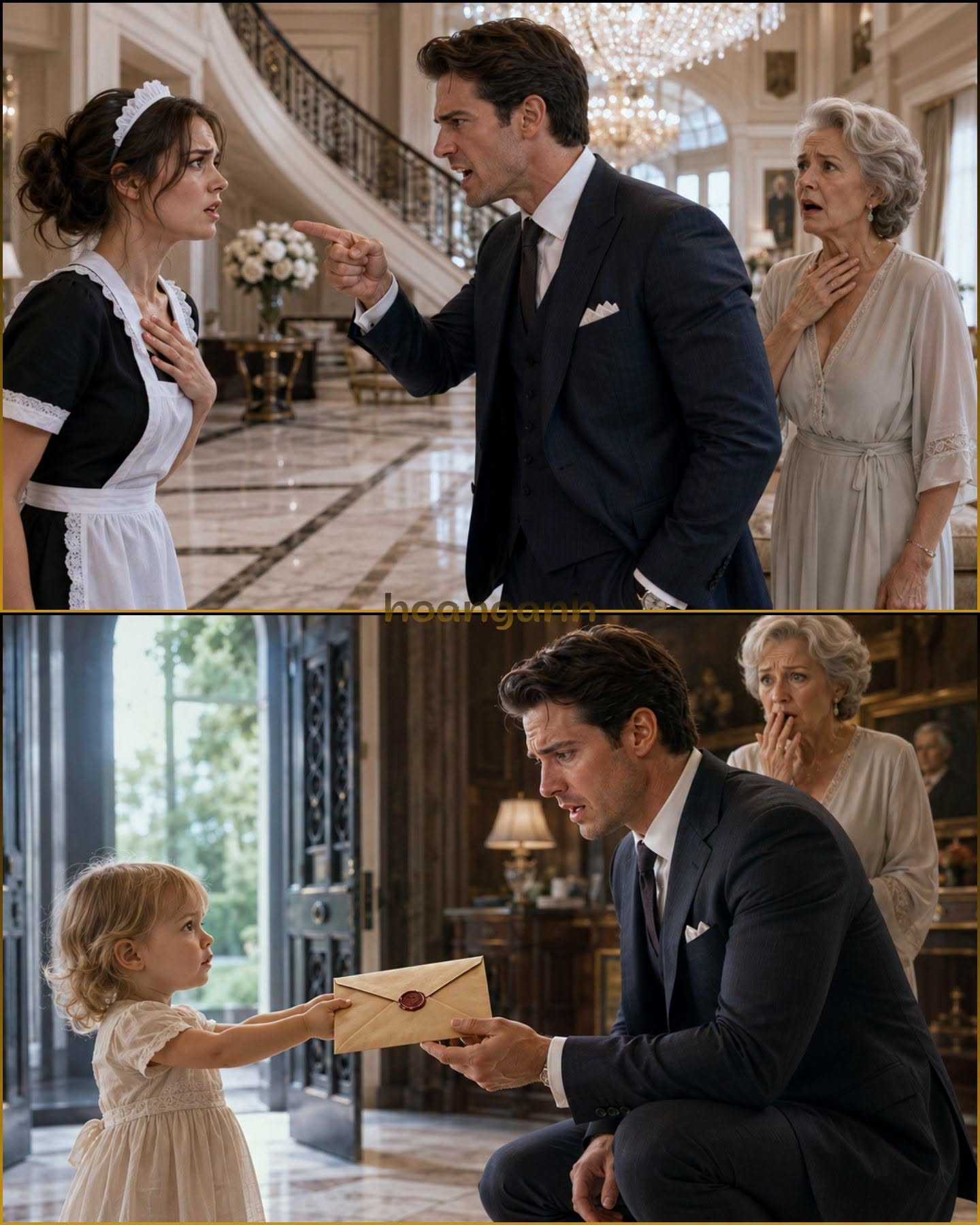
“Mommy told me to give you this if she ever disappeared.”
The little girl said it so softly that, for one terrible second, Graham Whitlock thought he had imagined it. She stood beneath the twelve-foot chandelier in the front hall of his Charlotte estate, rainwater dripping from the hem of her purple coat onto the marble floor, one mitten missing, her stuffed elephant tucked under her arm like a wounded soldier. In her other hand was a wrinkled white envelope, folded so many times it had nearly split at the corners.
Graham had faced hostile takeovers without blinking. He had watched competitors crumble, banks threaten, lawyers circle, and reporters turn grief into headlines after his divorce. At thirty-four, he had built Whitlock Development into a company with projects from North Carolina to Colorado. His name sat on towers, hospitals, tech campuses, and luxury condos. Yet nothing in his life had prepared him for a three-year-old child looking up at him with swollen brown eyes and saying the word disappeared like it was a place her mother had gone by accident.
Behind the child stood Ruth Bennett, the maid’s aunt, a thin woman in her late fifties with damp gray hair and a face exhausted by worry. Ruth kept one hand on the little girl’s shoulder, as if afraid the child might drift away too.
Graham did not take the envelope immediately. His eyes went first to the child’s coat, then to her muddy shoes, then to the toy elephant. He recognized them all. He had seen that purple coat folded on the bench in the laundry room. He had stepped over that elephant more than once near the kitchen island. The little girl’s name was Lily Bennett, though everyone called her Lil. Her mother, Claire Bennett, had been Graham’s housekeeper for nearly two years.
Had been.
Four days earlier, Graham had accused Claire of stealing his dead mother’s gold locket.
Three days earlier, he had told her not to return to the house until he decided what to do.
Two days earlier, she had vanished.
Now her toddler was standing in his foyer with an envelope meant for him, and Graham suddenly understood that the missing locket was not the real story. Maybe it had never been the story at all.
He crouched, bringing himself level with Lily’s face. “Your mommy gave this to you?”
Lily nodded. Her lower lip trembled, but she fought it bravely. “She said only Mr. Graham. Not Mr. Porter. Not the shiny lady. Only you.”
The shiny lady.
Graham felt something cold move through his chest. Celeste, his ex-wife, still wore satin in the morning and diamonds to charity meetings. Lily had always called her shiny because no adult had ever corrected her. Mr. Porter was Porter Vance, Graham’s chief of staff, the man who controlled the estate calendar, household accounts, security schedules, and every detail Graham had been too tired to care about after his mother died.
Graham took the envelope. Across the front, in Claire’s careful handwriting, were six words.
For Graham Whitlock. If I disappear.
His fingers tightened until the paper crinkled.
Ruth swallowed. “She told me to bring Lily here first. I didn’t want to. I thought maybe the hospital should come first, or the police, or somebody who knows what to do. But Claire was clear. She said if anything happened, if she couldn’t speak for herself, Lily had to give you that envelope before anyone else got involved.”
Graham looked up sharply. “Hospital?”
Ruth’s mouth pressed into a line. “Read it.”
He opened the envelope.
Inside were three things: a handwritten letter, a small brass key taped to an index card, and a photograph of his mother sitting in the sunroom three years before she died. In the photo, Margaret Whitlock was smiling at someone outside the frame, her gold locket visible at her throat. On the back, Claire had written: She left more than jewelry behind.
Graham unfolded the letter.
Dear Mr. Whitlock,
If you are reading this, then I am either too sick to explain or someone has made sure I cannot come back to your house. I am sorry Lily is the one carrying this. I know that is unfair. But she is braver than most adults I know, and I trust her little hands more than I trust the hands of the people around you.
He stopped breathing for a moment.
The letter did not begin with excuses. Claire did not beg him to believe her. She did not curse him for accusing her, though he deserved it. She thanked him first, in the quiet, dignified way she had done everything. She thanked him for hiring her when she had no references except a diner owner, a church secretary, and a woman whose house she had cleaned while pregnant. She thanked him for letting Lily stay in the laundry room when childcare fell apart. She thanked him for never looking at Lily like she was a problem.
Then the words changed.
I did not steal your mother’s locket. I found it in the wrong place.
Graham read that line twice.
I found it inside a donation box in Mrs. Celeste Whitlock’s old suite two months ago, wrapped in a scarf I had seen Mrs. Whitlock wear at the Mercy Children’s Gala. I should have told you immediately. I know that now. But when I found the locket, I also found documents in the same box—copies of invoices, payroll transfers, and medical fund withdrawals that did not make sense. Your mother created a private employee hardship fund before she died. She called it the Oak Fund. It was meant for household staff, maintenance workers, cleaners, drivers, security guards, and anyone working under Whitlock properties who had nowhere else to turn.
Graham’s eyes moved to the brass key taped to the card.
I applied for help from that fund six months ago after my diagnosis. Mr. Porter told me no such fund existed. Then he told me that if I embarrassed your household with “personal troubles,” Lily could end up in state care if I became too sick to work. I believed him because frightened mothers believe threats when their children are involved.
The marble floor seemed to tilt beneath Graham’s shoes.
My leukemia came back in the spring. I tried to keep working because work made me feel normal, and because Lily needed rent, groceries, insurance, and mornings where she could still think clouds were pillows. I did not want pity. I did not want your money. I only wanted the help your mother had already left for people like me.
Graham lowered himself onto the bottom stair. Lily leaned against Ruth, watching him with solemn trust that hurt more than accusation.
The letter continued.
When I found the locket and the files, I realized the Oak Fund had not disappeared. It had been drained. Some of the money went through a charity connected to Mrs. Celeste. Some went through maintenance contracts approved by Mr. Porter. I copied what I could. I hid the copies where your mother hid the original fund instructions. The key is for the old music cabinet in the Oak Room. Mr. Porter told the staff never to enter that room after your mother died. I think he was afraid someone would find what she left there.
Graham looked down at the key.
Then came the line that broke him.
If you cannot forgive me for staying quiet, I understand. But please do not let them call me a thief in front of my daughter. Lily hears more than people think. She already lost enough.
Graham closed his eyes.
Four days earlier, Claire had stood in his study with her face pale and her hands clasped in front of her. Porter Vance had played security footage showing Claire entering the west hall near Celeste’s old suite. Celeste had stood by the fireplace, wounded and elegant, saying, “Graham, I hate to suggest it, but your mother’s locket was in that room. Who else had access?”
May you like


—————————————————
Say "suggestion" - Part 2 will be updated below 👇