Chapter 1 - The Calculus of Compassion
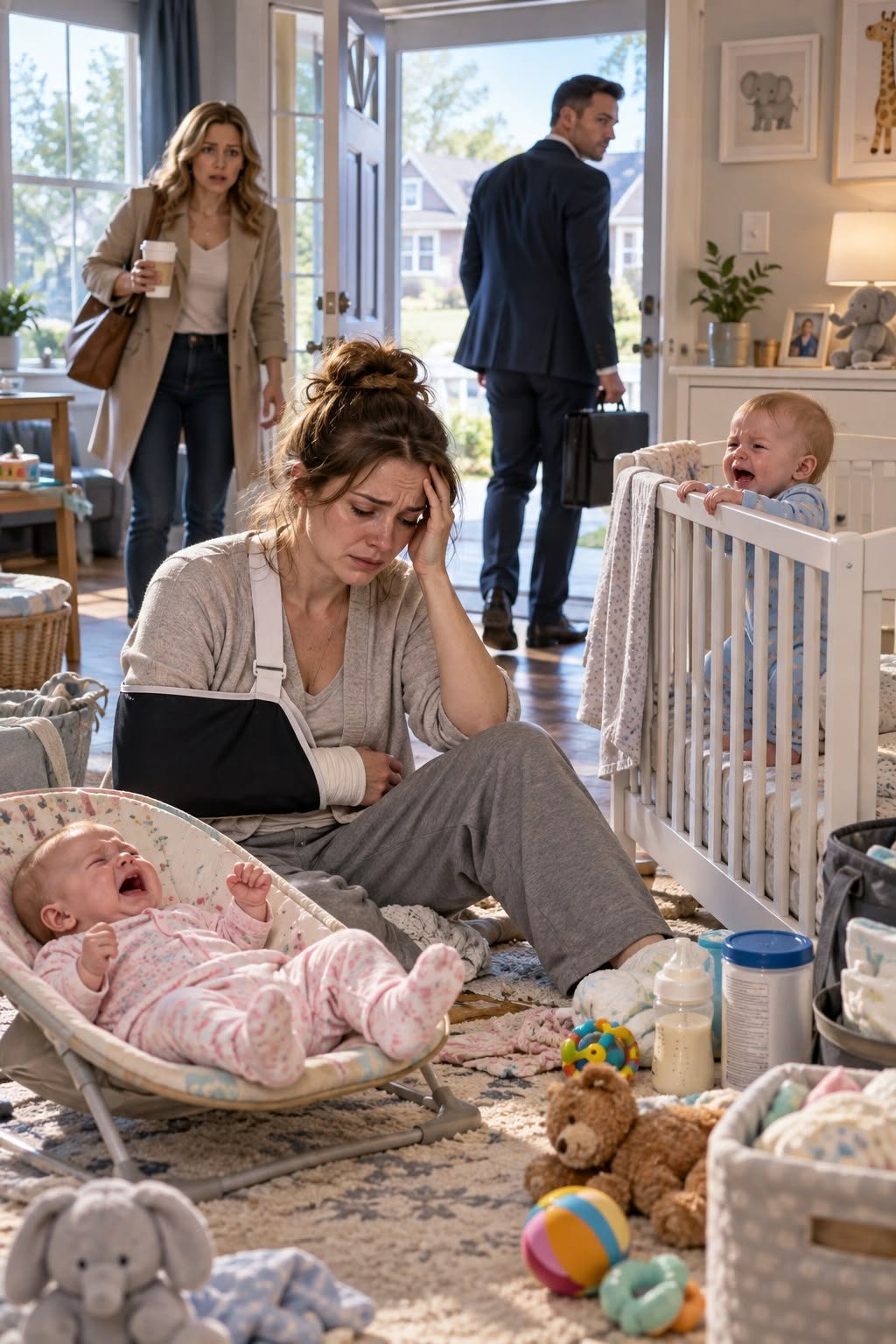
The fluorescent lights of the Naperville Urgent Care waiting room buzzed with a low, monotonous hum that seemed to mimic the dull throb radiating from my right wrist. I sat on the sterile examination table, my right arm cradled securely in a dark blue sling, feeling smaller than I had in years. The emergency physician had just delivered the diagnosis: a clean, stable fracture of the distal radius. No surgery, thank God, but absolute immobilization for at least six weeks, followed by physical therapy.
"You should not be driving until your orthopedist clears you," the doctor had told me, her voice professional and detached.
Then she added, her tone dropping into a firmer, more cautionary register, "And absolutely no lifting with that right arm. None."
I swallowed hard, the taste of dry panic rising in my throat. "What about babies?"
The doctor paused, her pen hovering over the digital tablet. "How old?"
"Five months. Twins."
Her expression shifted instantly from clinical detachment to sharp concern. "How much do they weigh?"
"About fourteen and sixteen pounds."
"Then absolutely not," she said, shaking her head. "You should not be carrying either baby right now. Your bones need stability to heal properly, and a sudden jerk from an infant could displace the fracture entirely. You need help, Mrs. Pierce."
Help.
I remember that word with startling clarity because just six hours later, my husband would act as though needing it made me fundamentally defective.
My name is Natalie Pierce. I was thirty-three years old. Colin was thirty-seven. We lived in a comfortable, mortgage-burdened colonial in Naperville with our five-month-old twins, Ruby and Owen.
We had been married for seven years. For nearly three of those years, we had fought a quiet, agonizing war against infertility. There had been endless specialist appointments, color-coded ovulation calendars, invasive bloodwork, and a devastating first-trimester miscarriage that felt like a physical tearing of my soul—a loss so early and quiet that half our relatives never even knew it happened.
Then, finally, the digital test turned positive.
And not just once.
Twins.
When the ultrasound technician pointed out two distinct, flickering heartbeats on the grainy monitor, Colin had laughed so loudly and with such unfiltered joy that I was certain people in the next room could hear him. He told everyone. His parents in Ohio. My sister Beth across town. Coworkers I’d never even met. He started calling the babies "our little team," wrapping his arms around my growing belly every night with a protective reverence that made me feel like the luckiest woman alive.
Later, those words would feel almost cruel.
Before the twins, my life had its own predictable, steady rhythm. I worked in account management for a major medical-supply distributor in downtown Chicago, commuting forty-five minutes each way on the BNSF line. Colin was a logistics operations manager for a national food distribution network.
We both worked full-time. We both did laundry. We both cooked badly enough that we ordered Thai takeout or pizza at least twice a week. We weren't the kind of marriage where every single household chore had to be calculated, monetized, and recorded on a spreadsheet.
At least, that was what I had blindly believed.
The fault lines in our partnership didn't appear overnight; they eroded slowly, grain by grain, beginning the moment we sat down at our kitchen island to discuss childcare when I was six months pregnant.
Twins changed the financial and logistical math of our entire existence.
When I called local infant centers, the numbers staggered me. One premier facility quoted us more than $3,300 a month for two infant spots. Another was slightly cheaper, but their waiting list was so long my children would be walking by the time a slot opened up.
When I laid the numbers out for Colin, my take-home salary—respectable by most standards—wasn't dramatically higher than the combined monthly cost of infant care.
Colin leaned back, rubbing his chin. "Why would we pay strangers almost your entire paycheck just so you can commute to a job that stresses you out?"
I hated that sentence the moment it left his mouth. "My paycheck isn't specifically assigned to daycare, Colin. It’s part of our combined household income."
"You know what I mean, Nat. It's simple economics."
Unfortunately, I did know what he meant. And down beneath the practical framing of simple economics, I knew what staying home meant for me, too.
My career paused. His didn't.
My retirement contributions paused. His didn't.
My professional network, my daily interactions with adults, my sense of independent identity—all paused. His continued to grow, fueled by promotions, office camaraderie, and uninterrupted focus.
Still, after weeks of emotional debate, we agreed. I would take my standard maternity leave and extend my time at home until the twins were around nine months old. Then I would return to the workforce.
Temporary. That was the word Colin used.
A family decision. That was the phrase we both repeated like a protective mantra.
The twins arrived at thirty-six weeks via scheduled C-section—small, fragile-looking things, but healthy enough to come home after four days in the NICU step-down unit.
For the first three weeks, Colin was a revelation. He was attentive, exhausted, and deeply involved. He changed diapers without being asked. He washed bottles. He took the grueling 2:00 a.m. feeding shift without complaining.
I remember once, at four in the morning, standing in our dimly lit kitchen wearing one mismatched sock while Colin held a squirming Owen against his chest, staring blankly at a box of instant formula and seriously asking whether coffee could expire. I laughed so hard my fresh C-section incision burned, the shared exhaustion binding us together in a fierce, protective bubble.
Then his paternity leave ended.
And almost overnight, the architecture of our marriage shifted.
At first, the new division of labor seemed reasonable, even natural. He worked outside the home. I was home with the babies. Naturally, I handled more of the daytime care.
But gradually, insidiously, "daytime" expanded until it consumed the entire twenty-four-hour cycle.
Night bottles became exclusively mine because Colin had high-stakes logistics meetings in the morning and needed his sleep. Pediatrician appointments became mine because I was "already off." Laundry, grocery delivery coordination, bottle sterilizing, formula ordering, prescription refills for Owen’s mild infant reflux—all of it migrated onto my mental load.
I became the designated chronicler of two tiny human beings. I tracked how many ounces each baby drank, which brand of hypoallergenic formula didn't upset their sensitive stomachs, and the exact nap schedules that could easily be ruined by a single stray lawnmower outside.
Colin still loved the babies. He was not a monster. When he walked through the front door at 6:00 p.m., he would scoop them up, toss them gently in the air, and make them shriek with laughter. He posted adorable pictures of them on his social media accounts, playing the role of the doting, hardworking modern father.
But parenting slowly became something Colin participated in when it was convenient, cute, or recreational.
For me, parenting had become the heavy, suffocating atmosphere I lived inside. There was no clocking out, no weekend break, no evening transition.
When the twins were three months old, I tried to voice my exhaustion. I cornered him in the kitchen while he was rinsing a protein shaker.
"Colin, I'm running on three hours of broken sleep. I feel like I'm drowning."
He smiled, kissing the top of my head with casual affection. "Just sleep when they sleep, babe."
I stared at him, my eyes burning with fatigue. "They don't sleep at the same time, Colin. When Ruby goes down, Owen wakes up. When Owen settles, Ruby needs a diaper change. There is no overlapping window."
"You know what I mean," he said smoothly, dismissing my reality with a cliché.
There it was again. You know what I mean. The linguistic shield he used whenever he didn't want to engage with the actual messiness of my daily existence.
At four months, desperate for a single hour of unbroken silence, I asked him to take care of both babies by himself for one Saturday morning so I could meet my sister Beth for breakfast at a local diner.
He blinked at me as if I spoke ancient Greek. "The whole morning?"
"Three hours, Colin."
"What am I supposed to do with both of them?"
I let out a breathless, disbelieving laugh, assuming he was joking.
He wasn't.
"Parent them," I said.
He survived. So did the babies. When I returned three hours later, the living room looked like a disaster zone—formula powder dusted across the coffee table, a dirty diaper left unceremoniously on the ottoman, and both babies crying in their bouncers while Colin stared blankly at his laptop screen.
Everyone was alive.
May you like

I remember thinking at the time: Good. We just need to do this more often. He needs to build his muscle memory.
Then I slipped on two wet garage steps while carrying a case of bottled water, threw my right hand out to break the fall, and heard a sickening pop that changed everything.