My Mommy Said Men Like You Leave”—The Mafia Boss Didn’t Know the Little Girl Beside Him Was His Daughter
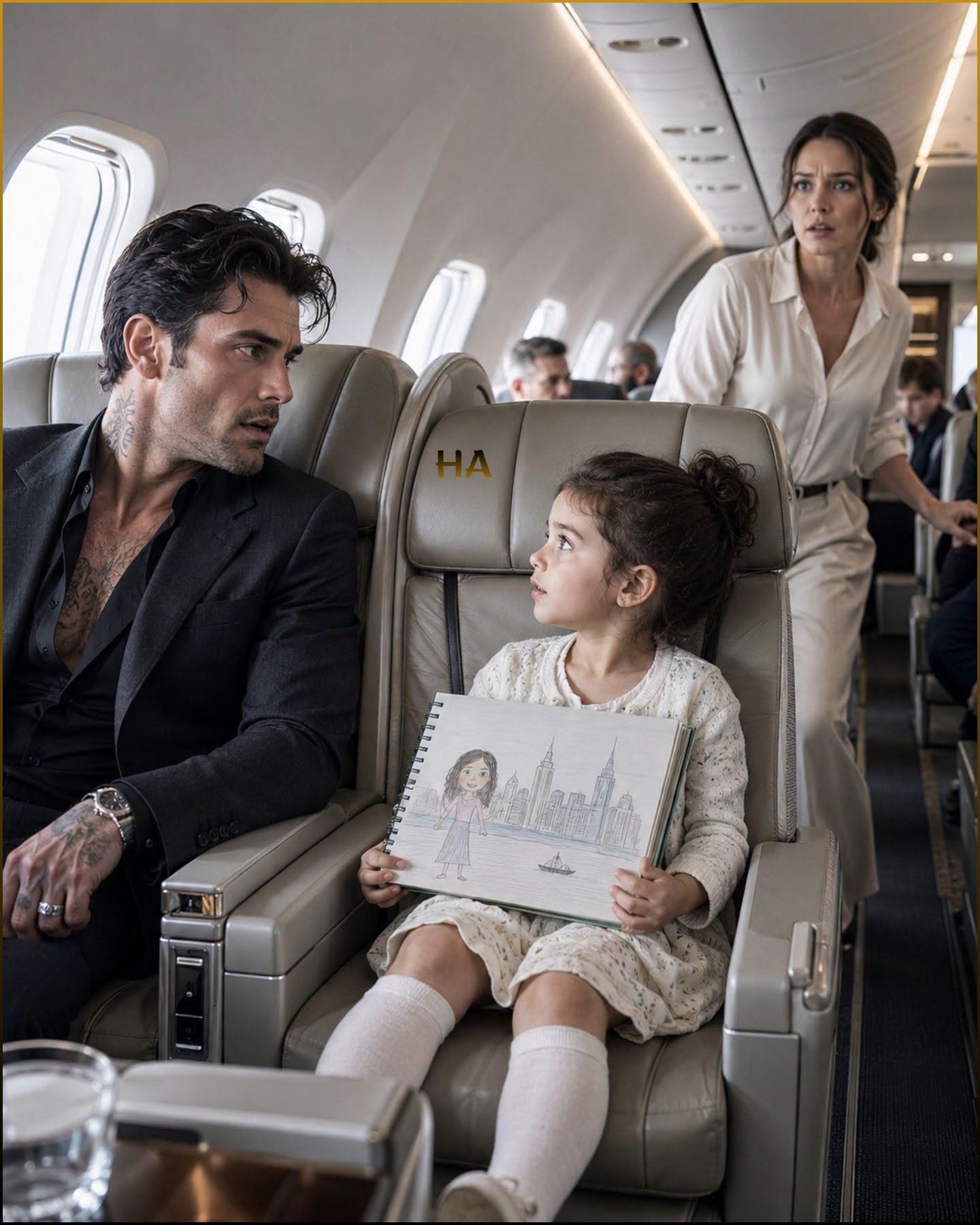
The first time Marco Moretti heard his daughter’s voice, she was sitting in seat 3B of a night flight from Seattle to New York, swinging her small patent-leather shoes above the carpet and studying him with the fearless suspicion only a four-year-old could afford.
He did not know she was his daughter then.
All he knew was that the child had his eyes.
Not similar eyes. Not the same color in the vague way strangers complimented babies in supermarkets. His eyes. A strange silver-gray that looked almost blue under airplane lighting and almost storm-dark when anger crossed them. The Moretti eyes, his grandmother used to say, were not inherited so much as declared. They came into the world like a family signature.
The little girl had them.
She also had a head full of dark curls tied with a white ribbon, a pink backpack with a stuffed rabbit clipped to the zipper, and the kind of serious little face that suggested she had already judged him and was waiting to see whether he deserved an appeal.
Marco Moretti, thirty-three years old, owner of half the luxury skyline in Manhattan and, unofficially, the most feared man between Brooklyn and the Jersey docks, should not have been unnerved by a child.
Men twice his size had lowered their voices when he entered rooms. Judges answered his calls. Union bosses remembered his birthday. Developers who thought themselves powerful learned to speak carefully once they realized what kind of empire existed beneath Moretti Holdings. Marco had been called charming, ruthless, generous, dangerous, impossible, and, once by a federal prosecutor who hated him, “a beautifully dressed nightmare.”
But the little girl in seat 3B looked at him for twelve full seconds and then said, “My mommy says men like you leave.”
Marco’s hand stopped on the cuff of his coat.
Across the aisle, the girl’s aunt, who had been wrestling a carry-on bag into the overhead bin, froze so sharply that Marco noticed. She was a warm-faced woman in her thirties, Korean-American, with a tired kindness around her eyes and the practiced panic of someone who had brought a small child onto a six-hour flight and was already negotiating with God.
“Lily,” the aunt said quickly. “We do not say things like that to strangers.”
The child did not look embarrassed. She looked disappointed that adults were once again hiding from the truth.
“I’m not being mean,” Lily said. “I’m asking.”
Marco slowly turned his head toward her.
“And what exactly are you asking me?”
Lily leaned closer, lowering her voice as if they were partners in a confidential investigation. “Do you leave?”
The question should have amused him. Instead, something cold moved through his chest.
He had left once. Not willingly. Not knowingly. But leaving was one of those crimes where the person abandoned rarely cared about the technicalities. The result was the same. Empty space. No explanation. A phone that never rang.
Before Marco could answer, the aunt stepped between them with an apologetic smile that did not reach her eyes.
“I am so sorry. She repeats everything lately. Divorce podcasts, cartoon villains, things from grocery store lines. Lily, honey, say sorry to the gentleman.”
Lily studied Marco’s face.
“I’m sorry if you leave,” she said.
The aunt closed her eyes.
Marco almost laughed, but the sound never made it out. The child’s eyes had trapped him. Those eyes and the shape of her chin. A small cleft. Barely there. The same one he shaved over every morning.
He looked at the aunt again. She had recognized him. He saw it in the way she avoided his gaze now, the way her hand tightened on Lily’s backpack strap.
Most people recognized him from business magazines or charity galas. Some recognized him from whispered stories. This woman’s fear had a different texture. It was not the fear of someone who knew what he could do.
It was the fear of someone who knew what he had done.
Or what she believed he had done.
The flight attendant arrived with a bright smile and asked if they needed help settling in. The aunt forced cheerfulness back into her voice and explained that the airline had separated their seats after a last-minute aircraft change. She had 3C, across the aisle. Lily was in 3B, beside Marco at the window.
“I can switch,” the aunt said immediately. “Sir, if you wouldn’t mind—”
Marco glanced toward seat 3C. A broad-shouldered man was already asleep there, headphones in, shoes off, dignity abandoned.
“It’s fine,” Marco said.
The aunt looked at him as if he had offered to hold a grenade.
“It’s a long flight.”
“I’ve survived worse.”
Lily raised her hand politely. “Do you snore?”
“No.”
“Do you lie?”
The aunt made a strangled sound.
Marco looked at the child. “Not to children.”
Lily considered that. “Okay.”
Then she reached into her backpack, pulled out a sketchbook, and opened it on her lap. The first page was filled with drawings of bridges, tall buildings, yellow taxis, and a woman with big curls holding the hand of a little girl under what looked like a city skyline.
Marco felt the cold in his chest spread.
“First time going to New York?” he asked.
Lily nodded without looking up. “Mommy says New York is too loud. Aunt Julie says New York is magic if you wear comfortable shoes.”
“Aunt Julie sounds wise.”
“She is. But Mommy is the boss.”
That almost made him smile. “What’s your mommy’s name?”
The aunt across the aisle turned her head so fast it was almost violent.
Lily, oblivious, uncapped a purple marker. “Naomi.”
The plane did not move. The cabin did not darken. No alarm sounded. Yet for Marco, the world dropped cleanly out from beneath the aircraft while it was still parked at the gate.
Naomi.
There were many women named Naomi in America. Thousands. Tens of thousands. That was what reason said. But reason had nothing to do with the way his pulse changed, or the way his throat closed, or the way the aunt named Julie went pale enough to confirm the damage before he even asked the next question.
“Naomi what?” he said quietly.
Julie’s face shifted from panic to pleading.
Lily drew a purple heart above the skyline and said, “Naomi Ellis. She designs pretty things and hates pickles and says if I ever meet a man with storm eyes, I should run.”
Marco Moretti forgot how to breathe.
Five years earlier, before the silence, before the funeral he never attended, before the lie that cut his life into a before and after, Naomi Ellis had sat beside him in business class on a flight from Atlanta to New York and stolen the armrest without noticing.
Marco had been twenty-eight then, not yet as polished into danger as he would later become, but already powerful enough that men watched him carefully. Publicly, he was the young president of Moretti Holdings, a real estate and technology conglomerate reshaping old neighborhoods into glass towers, smart buildings, and luxury mixed-use developments. Privately, he had inherited something older and darker from his father’s bloodline: a network of favors, debts, loyalties, dock contracts, protected routes, and men who did not appear on organizational charts.
He wore both lives with frightening ease. A charcoal suit with no tie. A gold ring on his right hand. Black hair brushed back from a face too beautiful for the things attached to his name. Ink curved beneath his shirt collar, the tail of a black swallow tattoo disappearing down his neck. The swallow had been his father’s mark, then his. Home, loyalty, return.
He had boarded that Atlanta flight irritated, overworked, and expecting six quiet hours of email.
Then Naomi Ellis smiled at something on her phone.
He noticed her first because she did not notice him.
That was rare enough to become interesting.
She was twenty-six, a Black American brand designer from Atlanta, flying to New York for a hotel rebranding project. She wore wide-legged cream trousers, a tucked white blouse, and gold hoops that caught the cabin light whenever she moved. Her curls fell over one shoulder in a thick dark cloud. She had a face that did not ask permission to be beautiful.
Marco tried to work. He failed.
When the flight attendant leaned in to offer champagne, Naomi looked up and realized her elbow was on the shared armrest.
“Oh,” she said, pulling back. “I’m sorry. Did I claim neutral territory?”
May you like

—————————————————
Say "suggestion" - Part 2 will be updated below 👇