I Installed Hidden Cameras to Protect My Son in a Wheelchair—Then I Saw What His Caregiver Did When She Thought No One Was Watching
PART 1
I walked out of an $80 million peso business meeting because I saw my son sitting on the kitchen floor.
His wheelchair was empty.
And the woman I had hired to care for my house was lying facedown beside him.
For one terrifying second, I thought Mateo had fallen.
Then I turned up the sound on my phone.
He was laughing.
Not smiling politely. Not forcing the weak little grin he sometimes gave his therapists.
My eight-year-old son was laughing so hard he could barely breathe.
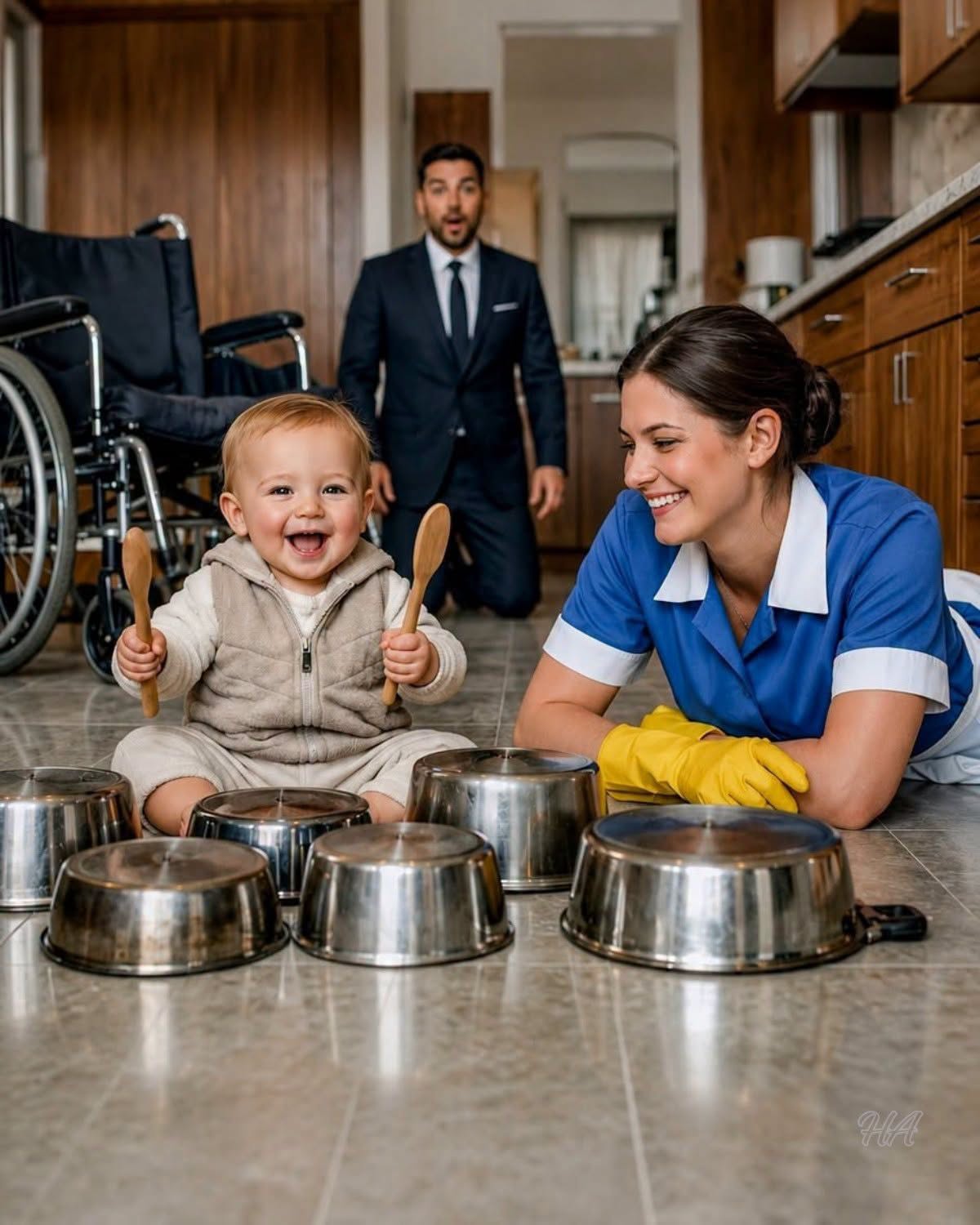
He held two wooden spoons in his hands and was pounding on a row of cooking pots. Across from him, Marisol—our new housekeeper—was stretched out on the tile floor, singing at the top of her lungs as if those dented pots were drums at a sold-out concert.
“Louder, Mateo!” she shouted. “The neighbors haven’t complained yet!”
Mateo struck the biggest pot.
The crash echoed through the kitchen.
Marisol threw both hands into the air.
“And the crowd goes wild!”
My son laughed again.
I stared at the security footage until the conference room around me disappeared.
Eight months earlier, Mateo had been sitting in the back seat when a semi crossed into our lane on the highway between Mexico City and Cuernavaca.
My wife, Laura, died that night.
Mateo survived, but the damage to his spine left him unable to move his legs.
I was driving.
The investigation cleared me. Witnesses confirmed the truck had entered our lane. The police report said there was nothing I could have done.
But reports don’t silence guilt.
Every morning, I still remembered Laura screaming my name.
Every night, I still saw the headlights coming toward us.
After the accident, I did what I knew how to do.
I worked.
I hired specialists, nurses, physical therapists, and caregivers. I bought Mateo the best wheelchair available. I turned our home in Lomas de Chapultepec into something between a rehabilitation center and a private hospital.
Everything ran on a schedule.
Medication at eight.
Therapy at ten.
Lunch at noon.
Rest at two.
Mateo was always clean. Always supervised. Always safe.
And almost never happy.
I told myself happiness would return when his body healed.
The doctors never promised that it would.
I installed the hidden cameras after discovering one of his caregivers yelling at him because he had spilled juice on his clothes.
She didn’t know I was watching.
Neither did the others who came after her.
From that point on, I monitored everything. I convinced myself that distrust was the same thing as protection.
Then Marisol arrived.
She had been working for us for only two weeks.
She wasn’t a nurse. She didn’t have impressive certificates or recommendations from wealthy families. She was there to clean, prepare simple meals, and help keep the house organized.
But as I watched her on my phone, she did something none of the professionals had managed to do.
She made my son forget the wheelchair beside him.
I replayed the video three times.
Maybe I was moved.
Maybe I was jealous.
Maybe I was angry because a woman who had known Mateo for fourteen days had reached a part of him I hadn’t been able to reach in eight months.
I left the meeting without explaining myself.
During the drive home, I kept hearing Mateo’s laughter through the car speakers.
It should have made me happy.
Instead, it made me feel like a stranger in my own son’s life.
When I entered the house, I heard another crash from the kitchen.
“Harder, champ!” Marisol yelled. “Let’s make sure they hear us all the way in Guadalajara!”
Mateo burst out laughing.
I stepped into the doorway.
The laughter stopped.
Marisol jumped to her feet so quickly that she nearly slipped. The color drained from her face.
“Mr. Cárdenas…”
Mateo lowered both wooden spoons.
His smile disappeared.
That hurt more than anything else.
Marisol looked from me to the pots scattered across the floor.
“I finished the cleaning,” she said quickly. “Mateo was upset, so we only played for a few minutes. I’ll put everything away.”
“Leave it.”
She froze.
“Sir?”
“Leave everything exactly where it is.”
Her hands began to shake.
I looked at the empty wheelchair against the wall. Then at my son sitting on the floor.
“How did he get down there?”
“I helped him.”
“Without asking me?”
“He wanted to sit on the floor.”
“He has a spinal injury.”
“I supported him the entire time.”
“You’re not his physical therapist.”
“No.”
“You’re not his nurse.”
“No, sir.”
“Then why are you doing things nobody hired you to do?”
Mateo flinched at my voice.
I saw it.
And still, I couldn’t stop.
“You were hired to clean this house,” I said. “Not to interfere in my son’s life.”
Marisol’s fear disappeared.
She looked directly at me.
“Your son doesn’t need another person staring at him with pity.”
My jaw tightened.
“You’re overstepping.”
“He needs someone to look at him like he’s still a kid.”
“You’ve known him for two weeks.”
“And in those two weeks, I’ve learned that he loves music, hates peas, cheats at card games, and pretends to be asleep when he doesn’t want to do therapy.”
Mateo stared at the floor, but I saw the corner of his mouth move.
I felt something hot rise in my chest.
“Are you saying I don’t know my own son?”
“I’m saying you know his medication schedule better than you know what makes him laugh.”
The words landed harder than I expected.
I took a step toward her.
“Are you calling me a bad father?”
“No.”
Her voice softened, but she didn’t look away.
“I’m saying Mateo lost his mother that night.”
The room went silent.
Marisol glanced at him before finishing.
“And ever since then, he’s been losing his father too.”
I couldn’t breathe.
No employee had ever spoken to me that way.
No friend had dared.
Even my own family avoided mentioning Laura’s name around me, as if grief were a dangerous animal sleeping inside the house.
I looked at Mateo.
He was still holding the wooden spoons, but the boy who had been laughing moments earlier was gone.
“Mateo,” I said. “Do you feel that way?”
He didn’t answer.
“Look at me.”
His fingers tightened around the spoons.
“I said, look at me.”
“Please don’t make him answer like this,” Marisol said.
“This is between my son and me.”
“That’s the problem.”
I turned toward her.
“You’re fired.”
Mateo’s head snapped up.
“No!”
It was the loudest word I had heard him say since the accident.
He dragged himself toward Marisol and wrapped both arms around her leg.
“Dad, please.”
My anger vanished.
Not slowly.
All at once.
Mateo was crying now.
“She didn’t do anything wrong,” he said. “She makes it quiet.”
I stared at him.
“What do you mean?”
He wiped his face with his sleeve.
“The bad quiet.”
I had no idea what to say.
Marisol crouched beside him and placed one hand on his shoulder.
Then she looked toward the decorative clock hanging above the kitchen doorway.
“I need to tell you something before you decide what happens to me.”
“I already know about the cameras,” she continued. “I found the one inside that clock three days after I started.”
My stomach tightened.
“You knew?”
“Yes.”
“And you still behaved like this?”
“I wasn’t hiding from you.”
She reached into the pocket of her apron and removed a small memory card.
“But someone else was.”
I stared at the card in her palm.
“What is that?”
“A recording from one of your cameras.”
“That footage is stored on my private system.”
“Not all of it.”
I felt the floor shift beneath me.
Marisol stood and lowered her voice.
“Someone has been deleting clips before you can see them.”
“Who?”
She glanced toward the hallway, as if she were afraid we might not be alone.
Then she said the words that changed everything I believed about my wife’s death.
“Your family has been hiding something from you for months.”
She placed the memory card in my hand.
May you like

“And the night of the accident wasn’t the first time someone tried to hurt Laura.”
❤️ THANK YOU FOR READING PART 1 🙏